
You’re sitting in a budget meeting asking yourself: What do NFC promotional products really cost, and how do I justify the higher upfront investment compared to classic promotional items? Many marketing managers across Europe are asking this exact question right now. The answer is simpler than expected, but it requires concrete numbers. You’ll find exactly those here.
This article gives you a direct price comparison between classic and smart promotional products, explains how to calculate ROI internally, and gives you the arguments you need for your next budget conversation.
What NFC Promotional Products Cost: The Honest Numbers
NFC stands for Near Field Communication. A small chip inside the promotional item communicates wirelessly with the recipient’s smartphone. They hold the device briefly against the product, and a website, form, or video opens instantly. No app required. No scanning. Just tap.
The price difference compared to classic promotional items is real, but smaller than most people expect:
Price Comparison: Classic vs. NFC
| Product | Classic | NFC Version | Premium |
|---|---|---|---|
| Ballpoint pen | CHF 0.80 to 1.50 | from CHF 4.50 | approx. CHF 3.00 |
| Business card (50 pcs) | CHF 20 to 40 | from CHF 8.00 per card | approx. CHF 360 |
| Pin badge | CHF 1.20 to 2.00 | from CHF 3.80 | approx. CHF 2.00 |
| Keychain | CHF 1.00 to 2.50 | from CHF 3.50 | approx. CHF 1.50 |
| Sticker / label | CHF 0.10 to 0.30 | from CHF 0.80 | approx. CHF 0.60 |
| Table display | CHF 3.00 to 6.00 | from CHF 8.00 | approx. CHF 3.50 |
The production premium for an NFC chip is under CHF 0.50. What you pay on top of that covers integration, programming, and quality assurance. With reputable suppliers, every promotional item is tested before delivery.
Important to understand: the NFC chip has no battery of its own. It draws energy from your smartphone’s magnetic field. An NFC ballpoint pen therefore works permanently, with no maintenance and no technology wear.
The Hidden Costs of Classic Promotional Items
A classic ballpoint pen costs CHF 1.20. Sounds cheap. But what does it really cost?
Classic promotional items carry follow-on costs that rarely appear in the budget:
- New production for every campaign change (new trade show, new product, new phone number)
- Print costs for accompanying brochures, flyers, and information materials
- Storage costs for undistributed remainders
- Disposal costs for outdated leftover stock
- No data, meaning no knowledge about campaign effectiveness
An interactive promotional item with an NFC chip doesn’t have this problem. You update the linked website in the dashboard, and all previously distributed promotional items immediately display the new content. The promotional item itself stays unchanged in your customer’s hand.
Concretely: 500 classic ballpoint pens for CHF 600 need to be disposed of after the trade show if the QR code on the page has changed. 500 NFC ballpoint pens for CHF 2,250 remain an active marketing channel for as long as recipients use them.
ROI Calculation: How to Present the Numbers Internally
This is the core of this article. Here you get a step-by-step formula you can take straight into your next budget meeting.
Step 1: Calculate Cost per Lead
The formula is simple:
Cost per Lead = Total cost of promotional item / Number of leads generated
With classic promotional items, the calculation stops after the first part. You know the total cost, but you have no figure for leads generated. You simply don’t know whether the ballpoint pen was ever looked at again.
With NFC promotional products, you have both numbers.
Step 2: Use Realistic Tap Rates
Tap rate refers to the share of distributed NFC promotional items that are activated at least once. Based on current industry experience, the following benchmarks apply:
- Trade shows and conferences: 10 to 25% of distributed NFC promotional items are tapped
- Retail at point of sale: 5 to 15%
- Direct mail with NFC element: 8 to 20%
For comparison: QR codes achieve an average scan rate of 2 to 5%, because actively opening the camera creates a higher threshold. NFC typically outperforms QR codes on interaction rate by a factor of 2 to 4.
Step 3: Conservative Sample Calculation for a Budget Meeting
Assumption: trade show appearance with 200 NFC ballpoint pens (CHF 4.50 each).
- Total cost of promotional items: CHF 900
- Tap rate (conservative): 12% = 24 taps
- Conversion rate on landing page (form completed): 25% = 6 leads
- Cost per lead: CHF 900 / 6 = CHF 150
In B2B, cost per lead on LinkedIn Ads runs CHF 150 to 500. Via Google Ads in competitive industries it can be even higher. An NFC promotional item at a trade show therefore operates in the same range, while also delivering a physical touchpoint, a memory trigger, and a conversation starter.
Step 4: More Optimistic Scenario for the Counter-Argument
Same campaign, but with an 18% tap rate and 35% conversion:
- Taps: 36
- Leads: 12 to 13
- Cost per lead: CHF 69 to 75
Present both scenarios in the budget meeting. The conservative one as worst case, the optimistic one as best case. This comes across as more credible than a single number and pre-empts objections.
Step 5: Factor in Lifetime Value
An NFC promotional item isn’t activated once and set aside. A keychain with an NFC chip sits on a keyring for years. An NFC ballpoint pen sits on a desk for months. Every additional activation costs you nothing extra, but retroactively reduces your cost per lead.
If the same pen is activated three more times after the trade show and a lead results from the second tap, your cost per lead halves without any additional budget.
Direct ROI Arguments by Use Case
Not every campaign has the same goal. Here are the concrete ROI arguments for the most common use cases:
Trade Shows and Events
Classic scatter item: business card plus printed brochure. Cost: approx. CHF 3.50 per package. Measurable: not at all.
Phygital approach: NFC pin badge (from CHF 3.80) that leads directly to a product landing page with a lead form. Cost: similar. Measurable: every interaction. Additional benefit: you save the print costs for the brochure, because it’s available digitally and is always up to date.
B2B Sales
An NFC business card (from CHF 8.00) instantly transfers a digital vCard on tap, opens the LinkedIn profile, or leads to a personalised landing page with a calendar link for the follow-up appointment. No retyping. No forgetting. No pile on the other person’s desk.
The numbers: 10 sales staff, 50 NFC business cards each = 500 cards for approx. CHF 4,000. If each person books 3 additional appointments per year because sharing contact details works more smoothly, and each contract is worth CHF 2,000: return of CHF 60,000 on an investment of CHF 4,000.
That’s not a guarantee, but it’s a calculable argument.
Loyalty and Customer Retention
Current study data shows: customers who have had phygital experiences spend on average 30% more than customers without this interaction. Brand loyalty increases by 23%.
An NFC keychain (from CHF 3.50) as a physical loyalty element opens the current points balance, personal bonus, or latest offer on tap. No app download required. No registration required.
For a company with 500 active regular customers and an average annual revenue per customer of CHF 400: a 30% increase means an additional CHF 60,000 in annual revenue. The NFC keychain for all 500 customers costs CHF 1,750.
What to Watch Out for When Comparing Prices
Not every NFC promotional item supplier delivers the same quality. Here are the three most important quality criteria that explain the price differences:
1. Chip Quality and Write Protection
The NTAG213 is the industry standard for simple URL redirects. It stores up to 144 bytes, enough for a web address. Lower-quality chips without certified standards can cause read problems, especially through thicker materials like metal or double-layered plastic.
Make sure the chip is secured with write protection after programming. This prevents the content from being altered or overwritten externally.
2. Dashboard and Analytics
An NFC promotional item without a tracking dashboard is like a Google Ads campaign without conversion tracking. You pay, but you don’t know what’s happening. A reputable supplier provides a dashboard where you can see tap count, timestamps, device type, and with appropriate GDPR consent, the approximate location.
3. Flexibility of the Target URL
The key advantage of smart promotional products over printed QR codes is that you can change the target URL after the fact. Check whether your supplier allows this in your plan and whether it comes at an additional cost.
On the Smart Giveaway product page you’ll find all NFC promotional products with exact specifications, including chip type and dashboard access.
Budget Planning: Recommendations by Company Size
You don’t need a large campaign to get started. Here are three concrete entry points:
Entry Level (Budget under CHF 500)
Stick 200 NFC labels (from CHF 0.80 each) onto existing materials. Total cost: CHF 160. Linked to your Google review link or your landing page. Measurable results visible within 4 to 8 weeks. Risk: minimal. Learning effect: maximum.
Medium Engagement (Budget CHF 500 to 3,000)
500 NFC ballpoint pens for a trade show (CHF 2,250). Dedicated landing page with lead form. Tracking dashboard active. After the show: ROI analysis for the next budget meeting. This is the most commonly chosen entry point for SMEs.
Full Rollout (Budget CHF 3,000 and above)
NFC business cards for the entire sales team combined with NFC promotional items for campaigns. Integration with existing CRM systems (HubSpot, Salesforce). Retargeting pixel on the landing page, so people who tapped subsequently see relevant ads. This creates a cross-channel customer journey without any break in the experience.
FAQ: NFC Promotional Products Costs and ROI
How much more expensive are NFC promotional products compared to classic promotional items?
The premium ranges from CHF 1.50 to CHF 4.00 per item depending on the product. A classic ballpoint pen costs CHF 0.80 to 1.50, an NFC ballpoint pen from CHF 4.50. The difference becomes relative once you factor in the costs of accompanying brochures, new productions for campaign changes, and the lack of measurability of classic promotional items.
From what quantity do NFC promotional products become worthwhile?
There is no minimum quantity for proving ROI. Even 50 NFC stickers for CHF 40 can deliver measurable interactions. For trade show campaigns, quantities of 100 to 200 units are recommended so that the tap rate becomes statistically meaningful. For larger productions (from 500 units), unit costs drop noticeably.
How do I calculate cost per lead for my budget meeting?
The formula is: total cost divided by number of leads. Example: 200 NFC ballpoint pens for CHF 900, tap rate 12% (= 24 taps), conversion rate on the landing page 25% (= 6 leads), cost per lead: CHF 150. In the budget meeting, present both a conservative scenario (10% tap rate, 20% conversion) and an optimistic one (20% tap rate, 35% conversion) to realistically illustrate the range.
Can I reprogram the NFC chip after production?
Yes. You update the target URL in your supplier’s dashboard, and all previously distributed promotional items immediately display the new content. The chip itself is not altered. This is one of the biggest cost advantages over classic promotional items with printed QR codes, which have to be reproduced every time something changes.
What happens with my data and GDPR?
The NFC chip itself does not read any data from the smartphone. It only transmits a URL. What happens on the landing page after the tap (forms, cookies, analytics) is fully subject to GDPR (EU) or the DSG (Switzerland). This needs to be correctly implemented in the page setup, but it’s technically no different from any other website.
Want to run through the ROI calculation for your specific scenario? Request a free consultation now and work through the numbers for your next budget meeting together.

You might also be interested in
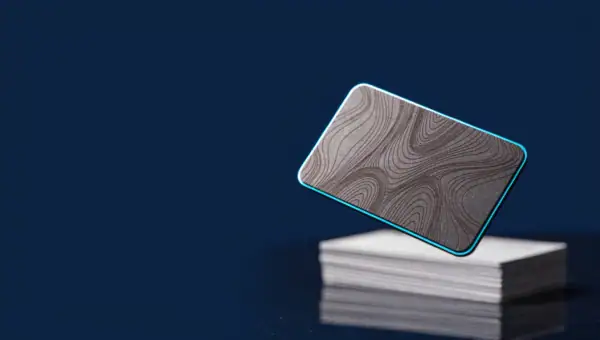
NFC Business Card vs. Paper: What Really Works Better
Costs, sustainability and impact in direct comparison — with concrete figures from real-world practice. Cost Comparison A paper business card costs approx.…
Read Articles →
NFC Business Card: Say Goodbye to Paper
Papiervisitenkarten verschwinden in Schubladen, und du weißt nie, was danach passiert. Die NFC-Visitenkarte ändert das grundlegend: ein Tipp mit dem Smartphone, und dein Kontakt landet direkt auf deiner digitalen Präsenz.
Read Articles →
NFC Promotional Products Cost: Prices and ROI Compared
You’re sitting in a budget meeting asking yourself: What do NFC promotional products actually cost, and how do I justify the higher…
Read Articles →